A Message from Director Winka Dubbeldam
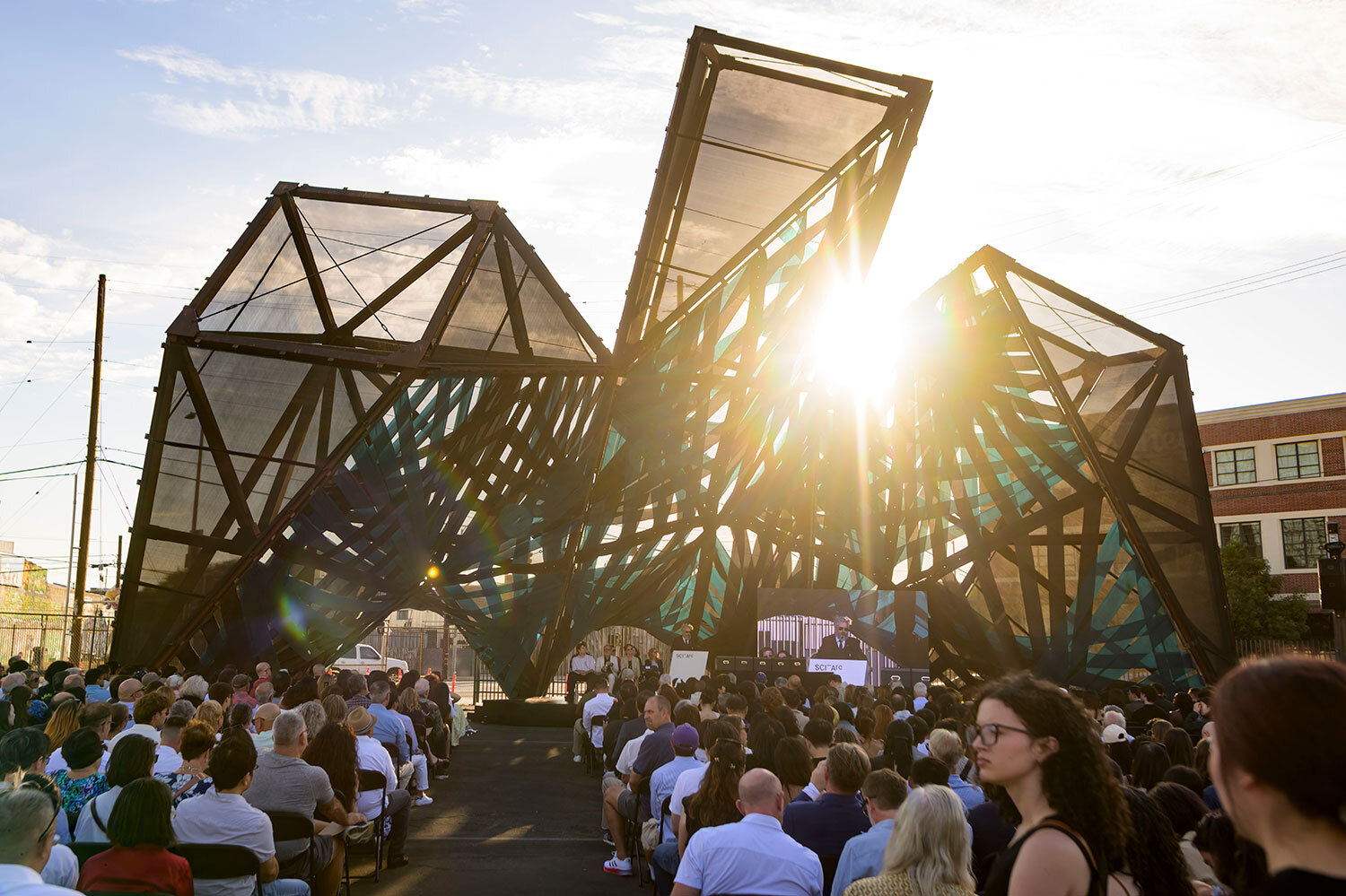
SCI-Arc has long been a place where architecture is understood not only as a professional discipline, but as a critical and speculative practice capable of shaping more equitable and inclusive futures. Experimentation, research, and intellectual risk-taking are central to our culture, and student work, emerging from a broad field of perspectives, remains at the heart of everything we do.
Since joining SCI-Arc in September, I have been inspired by the school’s bold spirit and its commitment to fostering a collaborative environment. I am honored to work alongside Darin Johnstone, Vice Director and Chief Academic Officer, following John Enright’s remarkable decade of leadership. We also recently welcomed Nathan Hume as Chair of our Graduate and Postgraduate Programs, joining Undergraduate Program Co-Chairs Marcelyn Gow and Kristy Balliet in advancing new initiatives and research agendas. I extend sincere gratitude to former Chairs David Ruy and Elena Manferdini, and to Hernán Díaz Alonso, whose visionary leadership continues to shape SCI-Arc’s trajectory.
After a seven-year hiatus, I am proud to welcome the return of ONRAMP with its eighth edition, an annual publication showcasing the extraordinary thesis work of our undergraduate, graduate, and postgraduate students from the 2024–25 academic year. This issue captures a moment of transformation at SCI-Arc, framed by reflections from our Chairs, Coordinators, and Faculty on the evolving role of architectural education, practice, and community responsibility.
The work featured in ONRAMP 8 addresses the challenges of our time, from climate resilience and ecological systems to robotics, autonomous fabrication, and living materials. It also reflects SCI-Arc’s engagement with Los Angeles as a community-centered site of learning and responsibility. Following the recent fires in Altadena and Pacific Palisades, SCI-Arc faculty and collaborators formed the Resilient Futures Task Force, led by Erik Ghenoiu, to support knowledge sharing, community engagement, and strategies for fire-resilient futures that are accessible and inclusive. This work culminated in the exhibition Architecture After the Fires: LA in Progress, highlighting architecture’s role in recovery, resilience, and care for all communities, and in a recent symposium with the winners of the exhibition.
Speculative design remains foundational to SCI-Arc’s ethos. At the school, speculation is not an abstract exercise but a critical tool for imagining inclusive futures, asking urgent “what if” questions, challenging assumptions, and opening new possibilities for architectural practice. Through advanced structural experimentation, robotics, material research, and AI-driven design, our students are developing architectures that are adaptive, responsive, and attuned to varied social and environmental contexts.
This is a moment defined by expanded research, inclusive pedagogy, and innovation across all levels of study. We are developing a Dual Degree program that will combine a Bachelor of Architecture (B.Arch) degree with an accelerated master’s degree in one of our postgraduate programs. A Master of Architecture (M.Arch) degree may also be combined with specialization options drawn from our postgraduate curriculum, leading to an accelerated Master of Science degree. Our postgraduate programs include Architectural Intelligence: Platforms, AI, Automation (formerly Architectural Technologies), reflecting SCI-Arc’s engagement with AI as a transformative tool for innovative and socially responsible design. Alongside Synthetic Landscapes, Design Theory and Pedagogy, and Fiction and Entertainment, these tracks position SCI-Arc at the forefront of architectural speculation, applied research, and fair access to emerging fields.
The accomplishments of our students continue to affirm the strength of this approach. This year’s recognition, including Werakul Srihahsan’s (M.Arch 2 ’25) Grand Prize at the AIA LA / ACLA 2×8 Resilience Competition and multiple students recognized in the Metropolis 2025 Future 100, underscores SCI-Arc’s role as a global incubator for visionary architects from many backgrounds.
As we reflect on the achievements of the past year, we stand at the threshold of new possibilities. SCI-Arc remains committed to redefining what architecture can be and whom it serves. We will continue to cultivate bold experimentation, critical inquiry, and applied research that respond directly to the complexities of our time. The work in ONRAMP 8 is not only a reflection of this moment, but a signal of the futures our students are prepared to build. I invite you to join us at SCI-Arc and engage with the ideas shaping what comes next.
Winka Dubbeldam
Director and CEO